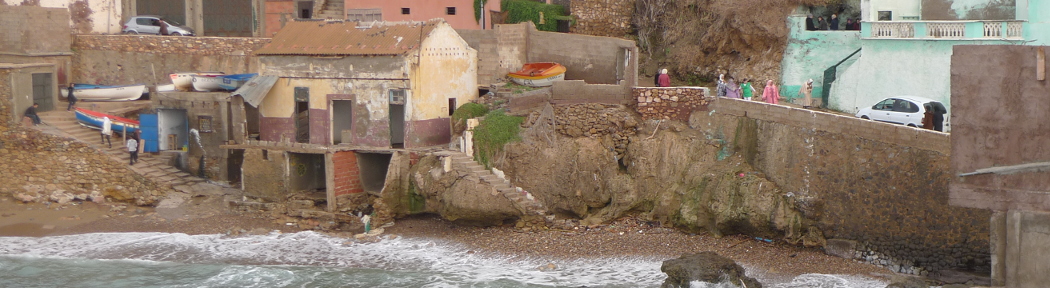
19. September 2012 · Kommentare deaktiviert für Senegal – Kanarische Inseln: 6.250 tote Boat-people 2006-2012 · Kategorien: Spanien · Tags: ,

Chahredine Berriah schreibt in einer Reportage in El Watan (19.09.2012) über den Slum Thiaroye-sur-Mer in Dakar (Senegal). Das Leben ist dort davon geprägt, dass die europäischen Fischfangflotten das Küstenland seit 10 Jahren in eine schwere Armut gestürzt haben. Die europäischen Unternehmen haben die lokalen Fischbestände ruiniert. Auf den Resten der lokalen Fischerflotille haben besonders Viele in den Jahren 2005, 2006 und 2007  versucht, auf heimlichem Weg die Kanarischen Inseln zu erreichen. 6.250 tote Boat-people haben Verbände von Familienangehörigen im Senegal im Zeitraum 2006-2012 registriert. Und Abertausende, die es geschafft haben, hat Spanien in den Senegal abgeschoben. Von diesen Boat-people-Realitäten ist besonders der Slum Thiaroye-sur-Mer in Dakar geprägt. Von den 60.000 BewohnerInnen dieser Siedlung am Ozean sind 2.000 als Boat-people auf der Fahrt zu den Kanarischen Inseln seit 2006 umgekommen, so die dokumentarischen Auskünfte.

http://www.elwatan.com/international/le-quai-aux-pirogues-maudites-19-09-2012-185850_112.php

19. September 2012 · Kommentare deaktiviert für Caritas Europa kritisiert Frontex · Kategorien: Algerien, Griechenland, Italien, Libyen, Mittelmeerroute · Tags: , ,

EU Ombudsman asked to look closer at FRONTEX

Article | | By Stanislava Gaydazhieva
Non documented migrants on the Italian coast. Since FRONTEX has begun operation their work on returning migrants is at issue | EPA/CARLO FERRARO ANSA

Caritas Europa, a network of 49 Caritas organisations across Europe, has sent a letter to the European Ombudsman Nikiforos Diamandouros expressing concerns about the way the European Agency for the Management of Operational Cooperation at the External Borders (FRONTEX) works.

The NGO said it was worried about the transparency of FRONTEX´s operations, the compliance with the principle of non-refoulement and the existing lack of clarity around the independent monitoring and complaint mechanism. Weiterlesen »

19. September 2012 · Kommentare deaktiviert für Griechenland: Neue Abschiebeknäste auf Lesbos, Samos, Chios und Rhodos in Planung · Kategorien: Griechenland · Tags:

http://infomobile.w2eu.net/2012/09/18/four-detention-centres-decided-for-lesvos-samos-chios-and-rhodos/

Four new detention centres for Lesvos, Samos, Chios and Rhodos planned

Published on September 18, 2012 in Uncategorized.

Authorities are planning to set up four new reception centers for immigrants on islands of the Aegean (Chios, Lesvos, Samos and Rhodos) to cope with the rising influx of migrants and refugees into Greece by sea that has been prompted by more effective policing along the Turkish land border. The Greek police announced that in the period between August 1st and September 17, 2012, 44 arrivals of refugee boats were registered with a total of 831 refugees being arrested on the Aegean islands. Weiterlesen »

19. September 2012 · Kommentare deaktiviert für Protestmarsch Flüchtlinge – Soliparty in Berlin 24.09.2012 · Kategorien: Deutschland · Tags:

Am kommenden Montag, 24.9. ab 20 Uhr, gibt es in Berlin eine Soliparty für den Refugee-March, der gegenwärtig auf dem Weg nach Berlin ist.

Wir laden Euch alle dazu ein!!!!
„Gut-am-Montag Special“ im Möbel Olfe am Kotti, Reichenberger Str. 177, Kreuzberg
**Infos zum Flüchtlingsmarsch *** Essen gegen Spende *** danach Party mit DJ Tigre (HipHop) und DJ Banni (femme po & r’n’b)

In ihrer jüngsten Erklärung schreiben die protestierenden Flüchtlinge u.a.:

Wir kämpfen für die Verwirklichung einer auf Gerechtigkeit und Freiheit basierten Welt.
Wir, die streikenden und protestierenden Flüchtlinge in Deutschland, die einen 6-monatigen Kampf hinter sich haben, und uns aktuell in einem Protestmarsch von mehreren Hundert Kilometern befinden, geben bekannt:

  • Wir werden Abschiebungen abschaffen, weil wir überzeugt sind, dass der Lebensort eines Menschen allein auf seinem individuellen Willen und  seiner individuellen Entscheidung beruht und nicht auf die politisch-wirtschaftlichen Verhältnisse der Mächte, die Freiheit und Gerechtigkeit in ihren internationalen Schaufenster täglich zur Schau stellen.
  • Wir durchbrachen den eingekreisten Bewegungsradius der Residenzpflicht und unterlassen keine Tat, um ihn praktisch abzuschaffen, weil wir überzeugt sind, dass Bewegungsfreiheit eine der elementarsten Menschenrechte ist.
  • Wir verweigern das erzwungene Leben in den Isolationslagern für Flüchtlinge und die Philosophie einer solchen elenden Erfindung. Das erzwungene Leben in den Isolationslagern gleicht Folter. Wir können nicht mehr Zeuge der tragischen Folgen vom Leben der Menschen in solchen Unterkünften sein


19. September 2012 · Kommentare deaktiviert für Tunesiens graphische Revolution · Kategorien: Tunesien · Tags:
http://www.freewordonline.com/content/2012/09/tunisias-graphic-revolution/

*Tunisia’s Graphic Revolution*

The graphic novel Sidi Bouzid Kids attempts to articulate the realities and concerns
of the Tunisian youth who mobilised in last year’s revolution. But while the graphic
novel is warmly received in Tunisia, the real town of Sidi Bouzid is tense with
post-revolutionary skirmishes. Tunisia’s recent history is continually re-drawing
itself in art – from graphic novels to rap – but the lines of free speech are also
being re-drawn, and not always in artists’ favour.

“Youth is finally moving.  It’s beautiful,” says Fouad in Sidi Bouzid Kids to his
friend Mohamed, who is dying after setting himself on fire in December 2010.  This
optimism in a moment of personal agony hints at the unreal times Fouad and his
friends are living in, and the graphic novel Sidi Bouzid Kids draws us into their
world: their frustrations at the corrupt, decaying regime of Ben Ali, the normal,
sane, humanness of their cry for ‘karama’  (‘dignity’) in the face of its
authoritarianism, and the excitement and tensions of the revolutionary fevour that is
unleashed as Mohamed sets himself on fire.  Eric Borg worked with Alex Talamba to
produce Sidi Bouzid Kids as the dust was still settling on what became known as the
Jasmine Revolution – although whether the dust has settled yet in the real town of
Sidi Bouzid is debatable. Just last month over a thousand demonstrators gathered in
the worn-down town to protest the detention of a young activist by the new
Ennahda-dominated government.

Mohamed in Sidi Bouzid Kids is drawn from the now-famous Mohamed Bouazizi, who set
himself alight outside the local municipal office to protest his humiliation at the
hands of the clawing bureaucratic tyranny of Ben Ali’s regime, triggering protests
that culminated in revolution.

But while Sidi Bouzid Kids sought to articulate the desperation and desires of the
Tunisian revolutionary youth, a year after the revolution, the screening of a film
based on another bande dessinee –French-Iranian Marjane Satrapi’s celebrated 2007
film Persepolis – has highlighted the continued tensions in the country. After the
television station Nessma broadcast Persepolis in October 2011, the station was
stormed by Islamists – who some progressives and secularists fear are gaining a
foothold in the wake of revolution – and the television station was fined for
‘insulting sacred values’.  At the trial, the director of Nessma reportedly described
the situation as “the trial of ten million Tunisians who dreamed of having a
democratic country.”

With the Tunisian constitution still far from completed, how Tunisia writes this
revolutionary period into its history – which stories it tells itself, and how much
space it allows for stories and art to speak – will echo around the region, just as
Mohamed Bouzizi’s self-immolation sparked the cataclysmic worldwide events of 2011.
What are Tunisia’s stories now, and will the new gathering forces allow them to be told?

Tunisia in literature has often been a series of conversations that speak little to
one another, with the country as a terrain for the colonial literary imagination.
Reeling from the French public’s reception of Madame Bovary, Flaubert turned to
ancient Carthage – the ruins of which still coexist with revolutionary graffiti in
modern-day Tunis – for his work Salammbô, a novel set just after the end of the first
Punic War, which may have spoken less to Tunisians than to contemporary European
fashion, its subject matter fuelling the sensibilities of Art Nouveau.  It was a
honeymoon in Tunis that, in recovering from tuberculosis, Michel in André Gide’s The
Immoralist is fundamentally  changed, desiring now to peel away conventions to find
“the naked flesh beneath, the authentic being hidden there.”  But literature that
speaks – in different ways – to forms of Tunisia itself, bubbles up in, for instance,
the writings of French-language polymath Abdelwahab Meddeb, whose non-fiction
Printemps  de Tunis (Tunis Spring) was one of the first books to attempt a first
draft of what was, in 2011, being referred to as the ‘Jasmine Revolution’.
Similarly, Hassouna Mosbahi’s A Tunisian Tale, published in English translation in
2011 after its initial publication in Arabic in 2008, evokes the chaotic, gossipy,
violent and tender worlds of the Tunisian slums from which revolution was born.

The dynamics of bandes dessinées  are a little more egalitarian than French
nineteenth century literature – the graphic art form popular in France, Belgium and
parts of North Africa has lent itself to voicing the realities of contemporary
Tunisia.  Sidi Bouzid Kids, though written and illustrated by French and Romanian
artists, seems to have found itself in tune with post-revolutionary tastes,
advertised in bookshops and referenced in the media.   In 2012, though, spoken word
poetry performances similarly seem one of the prime mediums through which new
realities are expressed and reborn.  Rap/ hip hop has often been turned to, after the
Arab Spring, to find how the epochal-shift on Arab youth has expressed itself in art,
but in Tunisia it bubbles up equally in poems, bandes dessinées and street art.

In the wake of revolution, Tunisia’s art scene seems, to many, to be reborn – the
high-profile exhibitions of Tunisian art in both Tunisia and France in the last year
speak to the idea that spaces are opening up to explore identity, history, and
multiplicity so often trodden-down, like daily dignity, under the Ben Ali regime.
But how does this sit with the fact that, since the revolution, artists have been
detained for “disturbing public order”?  How does the freedom from authoritarianism
hard-won against the Ben Ali regime in 2011 segue into the events, last month, in
which Salafists attacked cultural events they deemed ‘un-Islamic’?

Salafist extremists are not particularly renowned for their developed sense of irony.
 But there was something a little funny-sad, if not straight out funny, at how they
attempted to shut down a screening of Persepolis – a film which, famously, tells the
story of an Iranian girl’s initial excitement with a new, revolutionary world of
multiplicity and justice, only to see it corroded cruelly, encroachment by
encroachment, by Islamic extremists.

There’s a similar duality to Sidi Bouzid, as symbol and reality.  Sidi Bouzid Kids
depicts the potency of the ideas, desires and demands that came together in
revolutionary protests in 2011.  One year on, the real town of Sidi Bouzid is tangled
in strikes, demonstrations and – in part – resistance to the now-ruling Ennahda
party.  Like Persepolis and the attempts to shut down the Persepolis screening in
Tunisia, the Sidi Bouzid Kids is also a loaded document, a snapshot of an unfinished
story, as the demands of the ‘kids’ continue to manifest.

André Gide and Flaubert appropriated Tunisia as static backdrop, but in their works
the land was also the site of transformation, both for their characters and for their
writing’s tone and style.  And in this transformative time for the country, there are
surely many stories yet to come – the question is whether the space can be carved out
in which all are given a voice.

Heather McRobie is a writer and journalist.  Her non-fiction book on literary freedom
will be published later this year and she is completing her second novel.  As a
journalist she has reported from Jordan, Israel, Egypt, Palestine, Tunisia, Bosnia,
Croatia and Germany for publications such as the Guardian, the New Statesman and
openDemocracy.  She is also completing a PhD on transitional justice in the Arab
Spring and works as a contributing editor and gender columnist for openDemocracy's
gender and equality section, 50.50.  Follow her on Twitter @heathermcrobie


19. September 2012 · Kommentare deaktiviert für Serbien: Festival gegen Grenzregime 06./07.10.2012 · Kategorien: Mittelmeerroute · Tags:
Call-out for the No Border Serbia meeting at the Zrenjanin Antifascist Festival
5. – 7. October 2012
+++ Come to ZAF! +++ Get involved in the resistance against the border
system in Serbia! +++
In the recent years, Serbia has turned from a country of transit for
undocumented migrants into a country where migrants are stuck for
increasingly longer periods of time. Under the pressure of approaching the
EU membership, Serbia has developed its independent asylum system and
reinforced border controls and deportation mechanism on the border with
Macedonia. It has also obediently cooperated with the EU’s efforts to keep
migrants out of EU — it has signed the readmission agreement with the EU
and developed the cooperation with Frontex, the EU agency for the
management and operational cooperation on the external borders of the EU.

The result of this is the increased repression of migrants in Serbia.
Hundreds of undocumented migrants living in make-shift jungles close to
the Schengen border with Hungary (especially in Subotica) are daily
persecuted by the police and fear violence, arrest, detention and
deportation.
Unfortunately there is a complete lack of migrant solidarity
mobilisations, and a relative lack of a discourse, critical of the
repressive EU policies and their externalisation in Serbia.

That’s why one of the focuses of the ZAF – the Zrenjanin Antifascist
Festival – this year will be the resistance against the border system in
the Serbian context and the critique of the EU migration politics.

The Zrenjanin Antifascist Festival (ZAF) will be held on 5th and 6th of
October in the Cultural Center of Zrenjanin (Zrenjanin, Serbia –
http://zaf.anarhija.org/?q=node/40)

We see ZAF mainly as an opportunity to confirm local and strengthen Balkan
anti-authoritarian relations. Although the festival is largely oriented
towards the Balkans, ZAF is open for all anti-authoritarians interested in
cooperation based on solidarity and mutual aid.

One focus will be the resistance against the border system, this segment
will start on Friday 5th of October with a getting-to-know-each-other
meeting, open for everybody who is interested in getting involved in no
border struggles in Serbia. During the second day of the festival (6th of
October), as a part of the program of ZAF, there will be a discussion
about the EU migration policy in Serbia and the possibilities of
resistance. On Sunday the 7th of October there will be an organizing
meeting in which results of the days before discussion about posibilities
of resistance can be intensified and the planning to put ideas into
practice will proceed.

Apart from that there will be several discussions (http://zaf.anarhija.org/?q=node/49), concerts (http://zaf.anarhija.org/?q=node/52) and an anarchist book fair (http://zaf.anarhija.org/?q=node/38).
If you are interested in attending the festival, or participating in the
program, especially if you need accommodation in Zrenjanin, please let us
know that you are coming in advance. Please note that accomodation places
are very limited, so providing your own sleeping arangements would be
great. Please get in touch with the organizers to consult the options of
accomodation.

If you come by car, it would be great if you could bring blankets,
sleeping bags and other warm stuff that the undocumented migrants, stuck
in Subotica on their way towards the EU, will be in need of, as the colder
months approach!

http://zaf.anarhija.org/

19. September 2012 · Kommentare deaktiviert für Die Zukunft der EU-Abschottung · Kategorien: Deutschland, Europa · Tags: ,

17.09.2012: Abschlussbericht der Gruppe zur Zukunft Europas der Außenminister Belgiens, Dänemarks, Deutschlands, Frankreichs, Italiens, Luxemburgs, der Niederlande, Österreichs, Polens, Portugals und Spaniens

Die Außenminister träumen davon, „den Außengrenzschutz des Schengenraums zu stärken (durch Schaffung eines „Europäischen Grenzschutzes“) und mittelfristig ein europäisches Visum zu schaffen.“ (S. 10)

http://www.auswaertiges-amt.de/cae/servlet/contentblob/626324/publicationFile/171784/120918-Abschlussbericht-Zukunftsgruppe-Deutsch.pdf

18. September 2012 · Kommentare deaktiviert für Marzouki ist nicht weit gekommen · Kategorien: Tunesien · Tags: ,

Der tunesische Übergangschef Moncef Marzouki hatte angekündigt, dass er heute mit Familienangehörigen auf einem Schiff bis nach Lampedusa fahren wollte, um der Toten des letzten Flüchtlingsschiffs zu gedenken. Zwischen 50 und 79 Menschen waren bei der Felseninsel Lampione 12 Seemeilen vor Lampedusa ertrunken.

Marzouki bestieg ein Schiff der tuneischen Marine. Nach einer Meldung von Radio Mosaique soll er von einigen Ministern und dem General Rachid Ammar, dem Befehlschef des tunesischen Militärs, begleitet worden sein.

Doch das tunesische Militärschiff mit Marzouki an Bord kam nur bis einige Meilen vor Sfax und machte dann kehrt. Im Internet-Ticker heisst es nun, dass Marzouki auf das Schicksal von Harragas aufmerksam machen wollte, die von der Küstenwache abgefangen werden.

http://www.tunisienumerique.com/tunisie-moncef-marzouki-sur-les-traces-des-immigres-clandestins/144690


18. September 2012 · Kommentare deaktiviert für 16 Harragas auf dem Meer vor Annaba (Ostalgerien) aufgehalten · Kategorien: Algerien · Tags: ,

Die algerische Küstenwache hat am 18.09.2012 ungefähr 11 Seemeilen vor der Stadt Annaba 16 Harragas aufgespürt und wegen unerlaubter Ausreise festgenommen.

http://www.elkhabar.com/ar/autres/dernieres_nouvelles/302899.htm

18. September 2012 · Kommentare deaktiviert für Passagiere aus Griechenland: systematische Passkontrolle · Kategorien: Deutschland, Griechenland · Tags: ,

http://www.taz.de/Offenbar-Verstoss-gegen-Schengen/!101824/
taz 17.09.2012

Offenbar Verstoß gegen Schengen. Bundespolizei steht auf Griechen

Bürger aus dem Süden der EU werden bei der Einreise besonders kontrolliert – verdachtsunabhängig. Ob das dem Schengen-Abkommen entspricht, ist fraglich.von Caroline Wenzel

Bundespolizei am Franz-Josef-Strauß-Flughafen in München: „Ob einer von denen Grieche ist?“   Bild:  dpa

STUTTGART taz | Ankunft Aegean Airlines A 3510 von Athen über Thessaloniki nach Stuttgart: Jeden Tag, bevor die Maschine landet, postieren sich mehrere uniformierte Bundespolizisten an der Fluggastbrücke.

„Bitte halten Sie Ihre Pässe bereit. Die Bundespolizei führt am Flugzeug eine Passkontrolle durch“, heißt es über Lautsprecher im Flieger. Die meisten griechischen Passagiere haben ihre Pässe schon vor der Durchsage gezückt. Sie kennen das Prozedere längst.

„Seit mehr als zwei Jahren erlebe ich jedes Mal, wenn ich mit dem Flugzeug anreise, eine Passkontrolle. Sowohl hier in Stuttgart als auch in München“, sagt der Unternehmer Lambis Tassakos. Er ist Inhaber einer Automobil-Zulieferfirma mit Niederlassungen in Stuttgart und Athen und fliegt häufig hin und her. Seine Sekretärin Christina Machaira ergänzt: „Mich haben sie schon mehrmals ausgefragt, warum ich hierher komme und was ich hier mache.“

Die Bundespolizei kontrolliert jeden Pass gründlich, zum Teil mit der Lupe. Alle ausländisch aussehenden Passagiere werden herausgewunken und befragt. Die Bundespolizei ist auf der Suche nach Flüchtlingen und gefälschten Pässen.

„Jegliche Sensibilität verloren“

„Ich fliege mindestens zweimal im Monat von Thessaloniki nach Deutschland. Bei jeder Reise werden in Deutschland die Pässe kontrolliert. Der Staat hat jegliche Sensibilität verloren“, ärgert sich Ute Thoma, die bei der Rückkehr aus Kreta kontrolliert wurde. „Laut Auskunft eines Bundespolizisten am Flughafen Stuttgart passiert das bei allen Flughäfen bei Flügen aus Griechenland und Italien. Was für eine Heuchelei für Europa!“

Die Bundespolizei wiegelt ab. „Bei den Kontrollen handelt es sich um Dokumentensichtungen bzw. Befragungen im Sinne des Schengener Durchführungsübereinkommens in Verbindung mit dem Bundespolizeigesetz. Damit handelt es sich nicht um Kontrollen, auch wenn Reisende dies so empfinden mögen.“

Ein Sprecher des Bundesinnenministeriums erklärt: „Zulässig sind Kontrollen, die aufgrund von Lageerkenntnissen oder grenzpolizeilicher Erfahrung erfolgen, auf die Verhinderung oder Unterbindung grenzüberschreitender Kriminalität gerichtet sind und auf der Grundlage von Stichproben und in nicht systematischer Art und Weise konzipiert und durchgeführt werden“. Konkrete Zahlen zur Häufigkeit der Kontrollen gebe es allerdings nicht, da keine Statistik geführt werde.

Häufigere Kontrollen

Seit im Frühjahr in Griechenland und Bulgarien Passfälscherwerkstätten ausgehoben wurden, haben sich die Kontrollen weiter verschärft. Offenbar ohne Absprache mit den griechischen Behörden. „Es stimmt, dass in den letzten Monaten an vielen deutschen Flughäfen Passagiere von aus Griechenland gelandeten Flugzeugen häufiger als in der Vergangenheit kontrolliert werden“, so der Sprecher der griechischen Botschaft in Berlin.

„Diese Kontrollen sind nicht im Einvernehmen mit den griechischen Behörden.“ Rechtsexperten sehen die Kontrollen skeptisch. „Um eine unzulässige Ersatzkontrolle handelt es sich, wenn Fluggäste eines Flugs von Athen nach Stuttgart unmittelbar nach dem Ausstieg am ‚Anlegerfinger‘ verdachtsunabhängig kontrolliert werden“, schreiben Volker Westphal und Edgar Stoppa in ihrem Buch „Ausländerrecht für die Polizei“.

Nicht der einzige klare Verstoß

Die Ausweiskontrollen in Stuttgart und München seien ein klarer und inakzeptabler Verstoß gegen die Schengen-Regeln, meinen auch die Grünen im EU-Parlament. Übrigens nicht der einzige. Die migrationspolitische Sprecherin Ska Keller ist überzeugt: „Die Bundesregierung ist auf dem Weg, der aus einem Europa ohne Grenzen wieder ein Europa mit Grenzen macht.“

Im Juni hatten sich die EU-Innenminister, allen voran Innenminister Hans-Peter Friedrich, CSU, über Änderungen am Schengen-Abkommen geeinigt. Die Reform sieht vor, dass in Fällen „extremer Migration“ die internen Grenzkontrollen zeitweise wieder eingeführt werden können.

Da jetzt neue Flüchtlingsströme aus dem Nahen Osten über die Türkei und Griechenland nach Europa drängen, lassen sich die längst vorhandenen Grenzkontrollen in Deutschland nachträglich auch den Bürgern gegenüber wunderbar begründen. Egal, ob sie nun legal sind oder nicht.