Der Machtkampf in Tripolis eskaliert. Die von den UN eingesetzte Regierung scheint keine militärischen Kräfte mehr zu haben, um auf die erstarkten militärischen Gegenkräfte zu reagieren. Regierungschef Serraj, der nur noch über italienische Leibwächter verfügt, befindet sich außer Landes. Italienische Militär-, Polizei- und Geheimdienstkräfte werden gerade evakuiert. Hintergrund der Eskalation ist der italienische Vorstoß nach Tripolis in den letzten Tagen: die italienische Botschaft wurde wiedereröffnet, ein italienisches Kriegsschiff ist im Hafen von Tripolis angekommen, die italienische Petrogesellschaft ENI nimmt neue Erdgasfelder vor Tripolis in ausbeutenden Besitz, und die italienische Regierung hat mit der Regierung Serraj ein Memorandum zum Aufhalten der Boat People unterzeichnet – offensichtlich einen Plan zur Seeblockade Westlibyens. In Libyen mehren sich die Stimmen, über alle verfeindeten Lager hinweg, die vor einem neuen Kolonialismus warnen. Die EU Pläne zum Aufhalten der Boat People könnten in den nächsten Wochen Makulatur werden.
Quelle: The Economist | 14.11.2017
The Mediterranean will be at the heart of Malta’s EU presidency—for all the wrong reasons
“ALL that concerns the Mediterranean is of the deepest interest to civilised man,” wrote Edward Forbes, a 19th-century naturalist. Europe’s great sea will loom large as Malta, the European Union’s smallest member, takes up the rotating presidency of its Council of Ministers for the first half of 2017. That is fitting, for the Mediterranean has defined the destiny of this speck south of Sicily. The Great Siege Road, which runs along the northern edge of Valletta, Malta’s handsome capital, recalls the island’s repulsion of Ottoman invaders in 1565, an act of defiance that resonated across Christian Europe. A covetous Napoleon said conquering the strategically located island was “worth any price”. Centuries later a bull-headed Maltese prime minister shoehorned a chapter on Mediterranean security into the Helsinki Accords, a cold-war compact between the West and the Soviet bloc.
Quelle: Herald & Review | 12.01.2017
VALLETTA, Malta (AP) — The leader of the European Union’s presidency says that record numbers of migrants will try to cross the Mediterranean this spring and he wants the EU to work with Libya now to stem the flow.
Maltese Prime Minister Joseph Muscat said Thursday that „we will have a crisis.“
Muscat said Europe can choose between „trying to do something now, or meeting urgently in April, May … and try to do a deal then.“
Quelle: Telepolis | 11.01.2017
Das Abkommen knüpft an einen Deal an, den der damalige Ministerpräsident Berlusconi mit „mehr Öl, weniger Migranten aus Libyen“ beschrieb. In Libyen sorgt das für Ärger, möglicherweise auch mit Russland
Die italienische Regierung hat am Montag ein Abkommen zur Migrationskontrolle mit Libyen geschlossen. Italien will die vom Westen unterstützte libysche Einheitsregierung mit Drohnen und Radareinrichtungen sowie der Bereitstellung von Ausrüstung und Ausbildung unterstützen. Im Gegenzug soll Libyen Anstrengungen unternehmen, irreguläre Grenzübertritte entlang der Landgrenze in der Sahara zu verhindern und Migranten in Länder wie den Niger, Tschad oder Sudan zurückzuschicken.
Quelle: MSF | 23.12.2016
If smugglers take advantage of rescue at sea, so be it. The alternative is letting people drown.
By Aurélie Ponthieu
The Financial Times reported that the European Union accuses MSF and other humanitarian organisations running search and rescue operations in the Central Mediterranean of working in collusion with smugglers or at least helping them to carry out their deadly trade. These allegations were made based on an internal report from the European border agency, Frontex. MSF requested Frontex to share this report with us, which they declined. Instead, they refute they accuse humanitarian agencies of collusion, but raise a number of concerns with our search and rescue operations.
Quelle: Il Fatto Quotidiano | 07.01.2017
L’Italia può vantare accordi di riammissione con Marocco, Algeria, Egitto e Tunisia. Ma da questi 4 Paesi arriva una parte minima dei migranti: secondo l’Unhcr, nel 2016 l’82% dei barconi arrivati sulla Penisola proveniva dalle coste libiche. Il problema è che il governo Al Sarraj, riconosciuto dall’Occidente, non controlla che una porzione limitata del territorio: „Un accordo si può pure fare – spiega Francesco Cherubini, docente di Diritto dell’Unione Europea alla Luiss – ma è inapplicabile“
di Gianni Rosini
Raddoppiare le espulsioni degli immigrati irregolari dalle attuali 5mila alle 10mila unità, si legge nella circolare di due pagine che a fine anno il ministero dell’Interno ha inviato a tutte le prefetture. Per farlo servono accordi con gli Stati di provenienza o di transito. Per questo nei prossimi giorni il ministro dell’Interno Marco Minniti volerà a Tunisi e Tripoli: “Dobbiamo affrontare il problema lì – ha detto il 5 gennaio – costruire un sistema di cooperazione che funzioni in Libia, Niger, Sudan, Tunisia”. “Per rimpatriare gli irregolari nei propri Paesi – spiega a IlFattoQuotidiano.it Francesco Cherubini, docente di Diritto dell’Unione Europea all’Università Luiss “Guido Carli” – sono necessarie intese con ogni singolo Stato ed essere riusciti a identificare la nazionalità del soggetto. Al contrario, il rimpatrio è possibile solo verso l’ultimo Paese di transito prima dell’entrata nell’Ue. Ma un accordo sui rimpatri con la Libia – dalla quale è passato l’82% dei migranti arrivati in Italia nel 2016 – è quasi impossibile o, comunque, inapplicabile”.
Quelle: Libya Herald | 06.01.2017
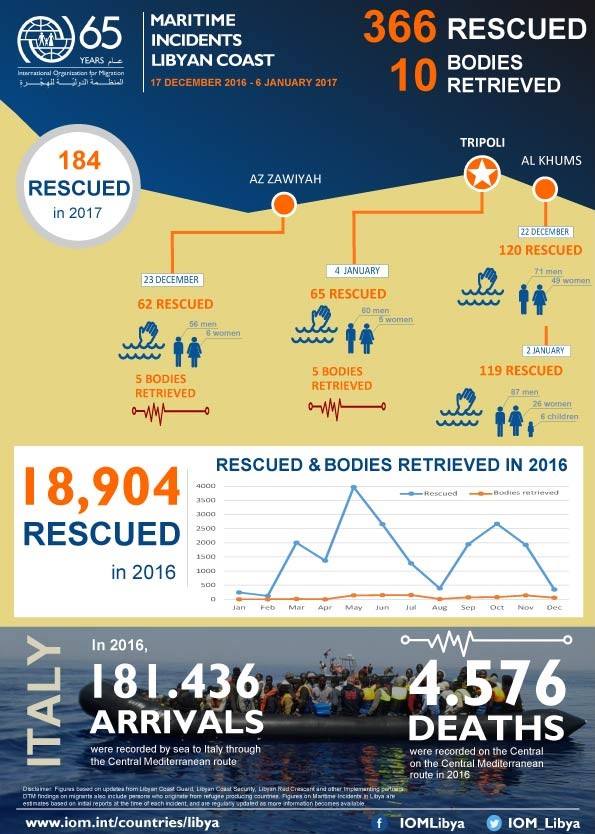
The International Organization for Migration Libya (IOM) has reported that already, 184 migrants have been rescued at sea off the Libyan coast. The migrants were rescued in two separate operations. In 2016 a total of 18,904 were rescued off the Libyan coast.
Between 17 December 2016 and 6 January 2017 a total of 366 were rescued and 10 bodies were retrieved at sea.
Off the western city of Zawia, 62 were rescued on 23 December (56 men and 6 women) and five bodies were retrieved from sea.
A total of 65 were rescued off the capital Tripoli (60 men and 5 women) and five bodies were retrieved on 4 January this year.
Meanwhile, 120 were rescued off Khoms (71 men and 49 women) on 22 December and another 119 (87 men, 26 women and 6 children) were rescued on 2 January this year.
In 2016, there were a total of 181,436 migrant arrivals by sea recorded in Italy from the Libyan coast and a total of 4,576 deaths at sea.
Middle East Eye | 05.01.2017
Erik Prince, the former CEO of the firm responsible for opening fire on Iraqi civilians, has the militarised solution to Europe’s migrant problem
Belen Fernandez
Starting the new year off with a bang, the Financial Times has just published a dispatch by Erik Prince, notorious founder and former CEO of the private security contracting firm Blackwater, the outfit responsible for projects such as the 2007 Nisour Square massacre of Iraqi children and other civilians.
The company has undergone a series of rebranding efforts over the years as an apparent means of distancing itself from overtly toxic connotations.
Prince’s Financial Times bio discreetly identifies him as simply “a former US Navy SEAL [and] executive chairman of Frontier Services Group,” a Hong Kong-headquartered entity.
According to its website, FSG offers “security and logistics services in frontier markets”.
Quelle: The Libya Observer | 05.01.2017
The Libyan Red Crescent, Tripoli branch, said it had rescued 80 migrants on Wednesday after they paddled ashore Tripoli beaches thinking they had arrived in Italy.
The Head of the Intervention Unit of the Red Crescent, Mohammed Al-Emam, said the Libyan Coast Guard told them about the boat and the survivors, so they started giving them humanitarian and medical care as soon as they arrived at the spot, adding that they transferred the survivors to the illegal immigration shelter centers.
Quelle: NZZ | 05.01.2017
Mehr als 180 000 Migranten sind vergangenes Jahr über das Mittelmeer nach Italien gekommen, so viele wie noch nie. Die Aufnahmezentren sind überfüllt. Ein neuer Konflikt mit der EU ist programmiert.
Andrea Spalinger, Rom
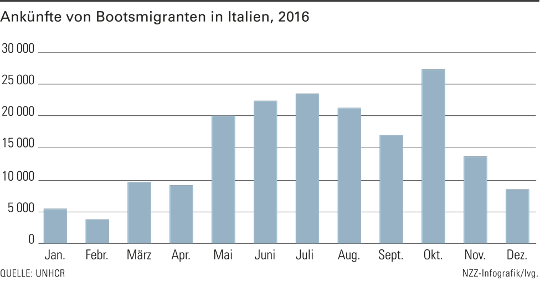
Die Ankunft von Bootsflüchtlingen in Sizilien und anderen Regionen Süditaliens sorgt weltweit kaum mehr für Schlagzeilen. Doch der Strom der Migranten, die von Libyen aus in Richtung Europa aufbrechen, lässt nicht nach. 2016 war sogar ein neues Rekordjahr. Laut dem Uno-Flüchtlingshilfswerk (UNHCR) sind 181 436 Bootsflüchtlinge nach Italien gebracht worden. Im Vorjahr waren es 153 842 gewesen. Während in Griechenland nur noch wenige Boote ankommen, seit die EU im März ein Abkommen mit der Türkei geschlossen hat, herrscht auf dem Mittelmeer vor der libyschen Küste selbst im Winter Hochbetrieb. Die italienische Küstenwache, europäische Rettungskräfte und private Helfer retten noch immer täglich Hunderte von Menschen aus Seenot.