06. Oktober 2017 · Kommentare deaktiviert für „The Financial Journey of Refugees“ · Kategorien: Lesetipps · Tags:

IHS | 09.2017

Executive Summary

The Financial Journeys of Refugees investigates what money and financial transactions can reveal about the journeys and experiences of forced migration. We examine money as a key node of the displacement experience: fueling transactions among formal and informal actors along the way; determining livelihood options; shaping or restructuring kinship networks; and coloring risks, vulnerabilities, or protective forces available to refugees. Our inquiry highlights these transactions and the power dynamics that unfold among refugees as well as between refugees and formal or informal authorities. Four specific areas of inquiry emerged during this study:
  1. How do refugees gather, move, store, spend, and make money along the journey of their displacement? How do their strategies lead to enhanced risk and/or self-protection along the way?
  2. How do financial transactions structure relationships among refugees, as well as between refugees and formal or informal authorities, such as smugglers, informal money transfer agents, and formal banking systems?
  3. How does the humanitarian system—and, in particular, cash assistance to refugees— shape the aforementioned financial transactions and relationships?
  4. What are the roles of refugee identity—in terms of gender, ethnicity, religion, and family status—and the documentation of that identity in shaping financial transactions, relationships, vulnerability, and coping strategies?

[…]

Download the Print Version
06. Oktober 2017 · Kommentare deaktiviert für „External EU Hotspots: The cat keeps coming back“ · Kategorien: Afrika, Europa · Tags: , ,

Jacques Delors Institut | 28.09.2017

Link to the Print-Version

The idea to set up EU hotspots in North Africa keeps coming up as European leaders seek enhanced control of mixed migration in the Mediterranean. Like the cat in Harry Miller’s comical song, external processing of asylum claims just won’t stay away. How realistic is it for the EU to establish external hotspots? This blog post outlines political, legal and practical issues related to the hotspots idea.

1 The recurring temptation of external hotspots

On 28 August 2017, French president Emmanuel Macron gathered the leaders of Germany, Italy, Spain and the European External Action Service (EEAS) to discuss migration in the Sahel region with the Heads of State of Chad and Niger and the Libyan Government of National Accord. For European leaders, the main objective was to intensify existing efforts to control migration towards Libya’s Southern borders and thus reduce perilous crossings on the Central Mediterranean Route. The resulting common declaration foresees, among several co-operation initiatives, “protection missions” in those three countries, aimed both at fighting human trafficking and setting up resettlement channels in cooperation with the UN High Commissioner for Refugees (UNHCR). President Macron presented this result as the concretisation of a controversial announcement he had made in July: his intention to set up ‘hotspots’ in Libya. In fact, the envisaged protection missions in Niger and Chad are far from constituting “EU hotspots”. Chad and Niger only accepted the establishment or repurposing of centres in which UNHCR-recognised refugees could apply for resettlement. As Chancellor Merkel noted, “Hotspots is probably not the best term to designate the centres”.

Weiterlesen »

06. Oktober 2017 · Kommentare deaktiviert für Interaktive Landkarte: Migrationsrouten aus den subsaharischen Ländern Richtung Europa · Kategorien: Afrika, Italien, Libyen, Medien · Tags: , ,

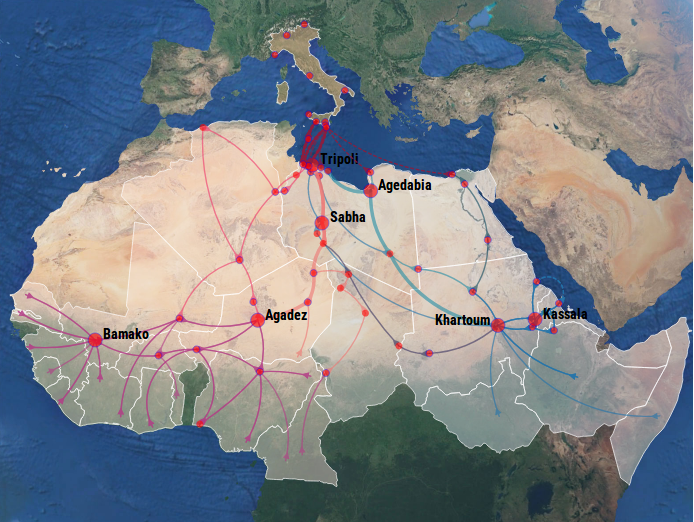
Die italienische NGO Ärzte für Menschenrechte hat eine interaktive Landkarte vorgestellt, auf der die Migrationsrouten aus den subsaharischen Ländern nach Europa dargestellt werden. Die Karte basiert auf den Berichten von 2.600 Migrant*innen, die MEDU in den letzten vier Jahren gesammelt hat.

medu | 05.10.2017

Medici per i Diritti Umani (MEDU) ha presentato oggi, presso la Sala della Stampa Estera a Roma, ESODI 2017 la nuova web map sulle rotte migratorie dai paesi sub-sahariani verso l’Europa.

ESODI è una mappa interattiva realizzata sulla base di duemilaseicento testimonianze raccolte da Medici per i Diritti Umani (Medu) in quasi quattro anni (2014-2017), di cui oltre la metà  nel solo 2017. La mappa interattiva – arricchita di video testimonianze, di grafici e di statistiche – racconta nel modo più semplice e dettagliato possibile le rotte affrontate dai migranti dall’Africa subsahariana all’Italia, le difficoltà, le violenze, le tragedie e le speranze attraverso le voci dei protagonisti.

Weiterlesen »

06. Oktober 2017 · Kommentare deaktiviert für Libyen: ein Gefängnis vor den Toren Europas · Kategorien: Italien, Libyen

Auf dem Festival der Zeitschrift Internazionale in Ferrara hat der libysche Regisseur Khalifa Abo Khraisse über die Situation der Migrant*innen berichtet, die in Libyen festsitzen.

Internazionale | 05.10.2017

Irene Lodi

Al festival di Internazionale è stato ospite anche lo sceneggiatore e regista libico Khalifa Abo Khraisse, autore delle Cartoline da Tripoli, che ha dialogato insieme a Stefano Argenziano di Medici Senza Frontiere e Nancy Porsia (giornalista freelance) della situazione dei migranti bloccati nella sua terra.

Weiterlesen »

06. Oktober 2017 · Kommentare deaktiviert für „Italian effort to stop migrants fuels bloody battle in Libya“ · Kategorien: Italien, Libyen · Tags: ,

Washington Post | 05.10.2017

By Maggie Michael | AP

It began when a Libyan militia paid by Italy to stop migrants heading to Europe intercepted a group of human traffickers offshore. That confrontation has spiraled into a weeks-long battle among rival militias for control of a Libyan coastal city that has left dozens dead.

The bloodshed in the city of Sabratha is in part an unexpected consequence of Europe’s effort to stem the flow of migrants from Libya across the Mediterranean. It illustrates how easily things can escalate out of control in the chaos of the North African country, where three different governments claim authority and the real power in many areas lies with local militias.

The Sabratha fight has expanded, bringing in outside factions, including Khalifa Hifter, the strongman who controls eastern Libya and is a rival of the weak, internationally recognized government based in Tripoli, headed by Fayez Serraj. Hifter appears to be using the conflict to obtain a foothold in the western part of the country.

Weiterlesen »

06. Oktober 2017 · Kommentare deaktiviert für „Vorstoss Haftars im Westen Libyens“ · Kategorien: Europa, Italien, Libyen

NZZ | 06.10.2017

In Benghasi hat General Haftar den IS besiegt. Nun weichen Partner des Warlords bei Tripolis Fronten und Loyalitäten auf.

Der selbsternannte libysche Feldmarschall Khalifa Haftar richtet den Blick nach seinem Erfolg gegen die Islamisten in Benghasi gen Westen. Schon im August waren seine Einheiten in die Gegend der Mittelmeerstadt Sirte vorgestossen, in der sich bis Anfang Dezember 2016 der Islamische Staat in Libyen verschanzt gehalten hatte. Nun rücken die Haftar nahestehenden Sintan-Brigaden von Süden her langsam gegen Tripolis vor, und in Sabrata, 50 Kilometer westlich von Tripolis, machen seine Loyalisten den dortigen Clans das Leben schwer.

Weiterlesen »

06. Oktober 2017 · Kommentare deaktiviert für „Tausende Migranten kehren in Heimatländer zurück“ · Kategorien: Griechenland · Tags: ,

Handelsblatt | 05.10.2017

Angesichts geringer Aussichten auf Asyl in Europa sind seit Anfang des Jahres gut 14.000 Flüchtlinge aus Griechenland in ihre Heimatländer zurückgekehrt. Allein im September gab es laut Polizei 1598 Rückführungen.

Knapp 14.000 Migranten sind seit Anfang des Jahres aus Griechenland in ihre Heimatländer zurückgekehrt. Dabei handele es sich größtenteils um Menschen aus Albanien, Pakistan, dem Irak, Georgien und nordafrikanischen Staaten, teilte die griechische Polizei am Donnerstag mit.

Weiterlesen »

05. Oktober 2017 · Kommentare deaktiviert für Sizilien: Migranten aus Tunesien landen an der Küste und verschwinden über den Strand – Video · Kategorien: Italien, Tunesien, Video

Corriere della Sera | 05.10.2017

Gli sbarchi fantasma in Sicilia: i migranti arrivano dalla Tunisia e poi si dileguano correndo in spiaggia

L’ultimo arrivo ieri, ad Agrigento. Venti o trenta persone sono sparite nel nulla dopo essere scese dal barcone. Mare Amico: «Almeno 80 sbarchi incontrollati da giugno». Il sindaco di Pozzallo a Minniti: «Qui arrivano delinquenti»

di Alessandro Fulloni

Le immagini fornite dall’associazione «Mare Amico» sono eloquenti. Sbarchi che si sono susseguiti a settembre sulle coste dell’Agrigentino. Il 6 sull’arenile di Giallonardo, il 7 a Ribiera, il 23 a Cannatello. Migranti provenienti dalla Tunisia dopo la «stretta» imposta dalle autorità italiane sulla direttrice Libia-Lampedusa. Ma stavolta non c’ è alcun controllo. I profughi sul barcone attraccano, scendono dal battello e scompaiono tra spiaggia e dirupi. Scene dalle tinte surreali riprese più volte in questi giorni: mare strepitoso, bagnanti in spiaggia. Chi prende il sole, chi fa footing sulla battigia: tra questi c’è chi osserva stupito l’approdo della carretta del mare salpata da chissà dove e in viaggio per centinaia di miglia.

Weiterlesen »

05. Oktober 2017 · Kommentare deaktiviert für „Beobachtungszentrum für Mittelmeer geplant“ · Kategorien: Europa, Mittelmeer · Tags: ,

nd | 05.10.2017

EU, NGOs und Wissenschaftler wollen gemeinsam Menschenrechtsverletzungen auf See dokumentieren

Von Sebastian Bähr

Offenbar soll ein unabhängiges Beobachtungszentrum für das Mittelmeer eingerichtet werden. Laut der Seenotrettungsorganisation Sea Watch haben sich Ende September in London Vertreter der EU, von NGOs, der italienischen Küstenwache sowie Wissenschaftler darauf geeinigt. Die Queen Mary Universität hatte die verschiedenen Organisationen zu der Konferenz »Tod auf See und die Gewährleistung von Such- und Rettungsmissionen« eingeladen.

Als Folge von »kontroversen Debatten« habe man dann ein Pilotprojekt zur Dokumentation von Menschenrechtsverletzungen auf dem Mittelmeer beschlossen. Die Londoner Queen Mary Universität und die Macquarie Universität von Sydney sollen die Verantwortung für das unabhängige Beobachtungssystem tragen. In einzelnen Arbeitsgruppen seien bereits erste Ansätze zur Finanzierung, zur Unabhängigkeit des Zentrums und zur Prävention gegen Datenmissbrauch ausgearbeitet worden.

Weiterlesen »

05. Oktober 2017 · Kommentare deaktiviert für „Amnesty kritisiert EU wegen Abschiebungen nach Afghanistan“ · Kategorien: Afghanistan, Deutschland, Europa · Tags: ,

Die Presse | 05.10.2017

„In ihrer Entschlossenheit, die Zahl der Abschiebungen zu steigern, wenden europäische Regierungen eine Politik an, die rücksichtslos und ungesetzlich ist“, heißt es in einem Bericht der Menschenrechtsorganisation Amnesty International über die Schicksale von Afghanistan-Rückkehrern.

Die Menschenrechtsorganisation Amnesty International hat der EU und den Regierungen der Mitgliedstaaten die illegale Abschiebung von Menschen nach Afghanistan vorgeworfen. 2016 seien in dem Land so viele getötete und verletzte Zivilisten dokumentiert worden wie seit 2009 nicht mehr, teilte Amnesty am Donnerstag mit.

Trotzdem seien im gleichen Zeitraum aus der EU rund 10.000 Afghanen abgeschoben worden, kritisierte AI in ihrem am Donnerstag veröffentlichten Bericht „Forced back to Danger„. 2017 zeichne sich bisher eine weitere Dramatisierung der humanitären Lage ab.

Weiterlesen »