15. März 2017 · Kommentare deaktiviert für Evacuate the camps, not the squats! · Kategorien: Griechenland · Tags: ,

w2eu | 14.03.2017

Despite appalling conditions in state-run camps, the government is taking repressive measures against refugee squats where specifically vulnerable persons have found refuge since the closure of the Balkan corridor

23,000-30,000 refugees currently still stay under appalling conditions in state-run mass camps in Greece. They live in tents in Moria Hot Spot, in Derveni camp in Northern Greece or Elliniko camp in Athens, in prefabricated houses in Koutsochero (18km out of Larissa City), Malakassa (Attiki) or Skaramangas Dock (Attiki).

Almost the same amount of people – 23,487 refugees – have been transferred mostly over the last months to alternative housing, i.e. in private homes, reception centres, hotels, and in host families co-ordinated and run by NGOs and funded by UNHCR mainly after having suffered in state run camps before.
Weiterlesen »

15. März 2017 · Kommentare deaktiviert für „Polizei räumt linke Hausprojekte in Athen“ · Kategorien: Griechenland · Tags:

nd | 14.03.2017

Selbstverwaltete Geflüchtetenunterkunft aufgelöst / Polizei nimmt sieben Aktivisten fest / Linke Szene macht SYRIZA-Regierung verantwortlich

Von John Malamatinas

Mit Protesten in mehreren Städten reagierte die radikale Linke in Griechenland auf die Räumungen von besetzten Projekten am Montag. Im Athener Stadtteil Zografou folgten über 1.000 Demonstranten dem spontanen Aufruf anarchistischer und außerparlamentarischer Gruppen. Es kam zu Auseinandersetzungen mit der Polizei. Demonstranten errichteten mit Barrikaden aus Müllcontainern, zerstörten die Scheiben von Bankfilialen und griffen die Polizeibeamten mit Steinen an. Die Beamten reagierten mit dem Einsatz von Tränengas und Schockgranaten.

Die griechische Polizei hatte am Montag mehrere besetzte Häuser in Athen geräumt. In den frühen Morgenstunden ging sie unter anderem gegen eine selbstverwaltete Flüchtlingsunterkunft im Zentrum Athens vor. Etwa 130 Geflüchtete, darunter Frauen und Kinder, wurden auf die Polizeistation Petrou Ralli gebracht. Der Großteil der Syrer wurde auf die Strasse gesetzt, nachdem ihre Identität aufgenommen wurde. Nur 31 Geflüchtete wurden in den staatlichen Einrichtungen untergebracht. Für die anderen Geflüchteten hatten die Behörden keine Lösung.

Weiterlesen »

15. März 2017 · Kommentare deaktiviert für La « forteresse » Europe commence en Afrique du nord · Kategorien: Algerien, Deutschland, Libyen, Marokko, Tunesien · Tags: ,

Algeria-Watch | 12.03.2017

Salima Mellah

Le 3 février 2017, les représentants de l’Union européenne réunis à Malte se sont séparés après avoir entériné un plan d’action destiné à freiner – et éventuellement arrêter – les arrivées de réfugiés en provenance de Libye principalement. Face à une situation incontrôlable dans ce pays, les dirigeants européens se tournent de plus en plus vers les pays voisins, la Tunisie, l’Egypte et l’Algérie afin de les pousser à respecter ou intégrer les dispositifs de gestion des flux migratoires qu’ils ont mis en place. La chancelière allemande Angela Merkel a fait personnellement le déplacement pour convaincre les responsables de ces Etats à coopérer moyennant de substantielles aides matérielles et financières. Si les rencontres n’ont pas abouti aux résultats escomptés, force est de constater que les pratiques de contrôle et de répression de ces pays se professionnalisent et s’adaptent progressivement aux exigences de leurs partenaires du Nord.

Depuis près de vingt ans la coopération en matière de répression de l’immigration est un aspect important de la politique nord-africaine de l’Europe et en particulier de l’Allemagne. Les frontières du sud de ces pays relèvent de l’une de ses priorités d’autant plus que l’instabilité politique persistante en Libye contraint les réfugiés à se rabattre sur des traversées de la Méditerranée plus longues à partir de l’Egypte, la Tunisie et l’Algérie. La chancelière allemande voulait lors de sa tournée nord-africaine aborder la situation en Libye et la coopération dans la lutte contre l’immigration clandestine. La visite en Algérie du 21 février a été annulée quelques heures avant le décollage de l’avion en raison d’une bronchite du président Bouteflika. A la surprise des responsables allemands qui savent très bien que depuis que l’état de santé du chef de l’Etat est chancelant, les rencontres officielles se font avec les membres du gouvernement. Merkel a toutefois réitéré son intention de se rendre le plus rapidement possible en Algérie. Elle s’est rendue également les 2 et 3 mars en Egypte et en Tunisie.

Weiterlesen »

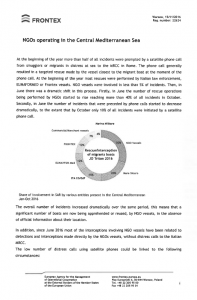
15. März 2017 · Kommentare deaktiviert für Frontex: NGO’s operating in the Central Mediterranean Sea · Kategorien: Mittelmeer · Tags: ,


Internal Frontex Report on NGO’s

14. März 2017 · Kommentare deaktiviert für DUBLIN III Returns to Greece · Kategorien: Europa, Griechenland · Tags:

w2eu | 14.03.2017

The European Union Commission suggested the resumption of Dublin Returns to Greece, beginning in March 2017. With this announcement, the European governments show that they close their eyes to the fact that the living and detention conditions in the Greek camps continue to be deplorable and inhuman, that access to the asylum procedure is still not guaranteed, that procedures remain dysfunctional in general and that many of refugees continue to suffer from inhuman and degrading treatment while being stuck in Greece. The European Commission’s recommendation included a gradual resumption of returns, with a first focus to return the ones who arrived in Europe after this date (15th of March) and not including unaccompanied minors or other vulnerable persons at that point.

Following these recent developments, many rumours have been created and hundreds of refugees started in panic to move onwards from Turkey and Greece, in order to reach the destination countries before that date. We therefore, decided to write this information sheet to explain some facts on who might be affected, to emphasise the grey areas, where it is unclear what will happen, and to give you advise on what can be done to prepare and protect yourselves – because we expect a new struggle on all levels against this new deportation threat.

Weiterlesen »

14. März 2017 · Kommentare deaktiviert für Video: Hungarian police violence at the border · Kategorien: Ungarn, Video · Tags:

Download here

14. März 2017 · Kommentare deaktiviert für Marokko: Flüchtlinge im Grenzgebiet blockiert · Kategorien: Algerien, Marokko · Tags:

Les Observateurs | 13.03.2017

Tabassés et sans nourriture, des migrants coincés à la frontière Algérie-Maroc

Depuis près d’une semaine, une quarantaine de migrants subsahariens sont bloqués dans un no man’s land entre le Maroc et l’Algérie. Les autorités marocaines et algériennes leur refusent l’accès à leurs territoires respectifs alors qu’ils sont privés d’eau et de nourriture.

Le groupe de migrants a finalement pu franchir la frontière algérienne, mardi 14 mars, a appris France 24 auprès de l’un des migrants.

Trois d’entre eux étaient blessés et ils ont reçu des soins au poste-frontière algérien, a-t-il ajouté.

Les autres membres du groupe ont rejoint la ville algérienne de Maghnia, à une vingtaine de kilomètres de la frontière avec le Maroc, où ils sont hébergés par des amis.

Weiterlesen »

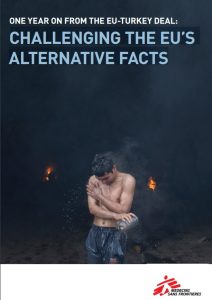
14. März 2017 · Kommentare deaktiviert für MSF: „Challenging the EU’s alternative Facts“ · Kategorien: Europa, Lesetipps, Türkei · Tags:

MSF

Introduction

One year ago, the ‘Balkan route’ – by which refugees, asylum seekers and migrants travelled from Greece to northern Europe – was closed. This route had constituted the only hope for thousands of people seeking protection in Europe. In the wake of this, on 18 March 2016 the European Union (EU) and Turkey issued the EU-Turkey statement, commonly referred to as the EU-Turkey deal. This deal aimed at stemming arrivals of asylum seekers and migrants from Turkey to Europe, and allegedly offered “migrants an alternative to putting their lives at risk”. Nine months later, the deal was reinforced with a joint action plan,2 a two-page document setting out further action to be taken.

These two interlinked events – the closure of the Balkan route and the EU-Turkey deal – represented a new paradigm in the EU’s approach to mixed migration flows. In reaction to the implementation of the EU-Turkey deal, MSF decided to no longer accept funds from the EU and its member states, in opposition to their damaging deterrence policies and their continued attempts to push people and their suffering away from European shores.

One year into the deal’s implementation, European leaders have been heralding its “positive results”, its “continued trend of progress” and its “steady delivery of results”, whilst acknowledging some “challenges” along the way. Most recently, EU member states such as Germany and Malta have called for the EU-Turkey deal to be replicated elsewhere.

Weiterlesen »

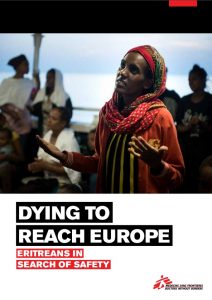
14. März 2017 · Kommentare deaktiviert für MSF: „Dying to reach Europe“ · Kategorien: Eritrea · Tags:

MSF

Eritreans in search of safety

“On 3 October 2016, a joint team from Médecins Sans Frontières (MSF) and SOS Méditerranée rescued 721 people from an overcrowded wooden boat drifting off the coast of Libya. Of these people, 685 (95%) were from Eritrea, and 197 (25%) of the Eritreans were unaccompanied children. Of the women on board, several were pregnant and others were severely sick. Many of those we rescued demonstrated physical and psychological trauma from beatings, rapes, threats and deprived living conditions throughout their journey – from Eritrea, through Ethiopia, Sudan and the Sahara desert to Libya. They showed us their scars and told us their terrible stories. We identified their ailments and treated them as best we could. The majority said they were aware of the dangers of crossing the Mediterranean Sea, but considered it their only option to seek safety and protection.”

14. März 2017 · Kommentare deaktiviert für „The Migration Crisis Is Over: Long Live the Migration Crisis“ · Kategorien: Europa · Tags: ,

MPI | 03.2017

By Demetrios G. Papademetriou

This commentary first appeared in Europe’s World, the policy journal of Friends of Europe.

Since the early spring of 2016, the number of people migrating across the Mediterranean has stabilized, to about 200,000 people. This is largely due to the closure of the Western Balkan route and the EU-Turkey Statement of March 2016, which sought to end irregular migration from Turkey to the European Union.

Underlying both actions is the newfound willingness of key European governments—Austria, Germany, and Sweden, among others—to ensure orderly procedures and „reasonable“ levels of openness. The resulting policy „recalibration“ has gradually changed both the terms under which asylum seekers are received, and the expectations of them; it has led to an increasing determination (albeit still mostly rhetorical) to remove both failed asylum applicants and outright economic migrants. The message to would-be migrants and each country’s general public is that illegal migration will no longer be tolerated.

Of course, people are still trying to reach Europe, both by land and by sea. Land routes include travelling to the Spanish enclaves of Ceuta and Melilla, while the sea routes mean continuous small-craft traffic toward Spanish shores, large numbers of crossings through the Central Mediterranean, and a small (but incessant) number of journeys across the Aegean.

Weiterlesen »