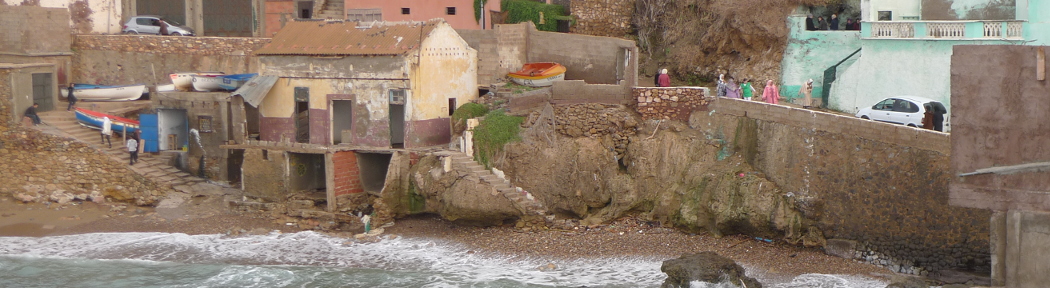
Die NZZ meldete am 06.10.2012: „Verwaltung in Sidi Bouzid gestürmt (dapd) · Hunderte Personen haben am Freitag den Verwaltungssitz in der tunesischen Stadt Sidi Bouzid gestürmt, in der vor knapp zwei Jahren die Protestwelle des Arabischen Frühlings begann. Die Beamten flohen vor der aufgebrachten Menge, die später von der Polizei mit Tränengas und Warnschüssen zurückgedrängt wurde. Die Demonstranten forderten die Freilassung von Menschen, die bei früheren Protestkundgebungen festgenommen worden waren.“ Kurz danach wurde der Gouverneur abgesetzt. Aber der Protest geht weiter. Inzwischen sperren die Bauarbeiter, die schon mehrmals die Stadt mit Barrikaden lahmgelegt haben, die Überlandstraßen. Ihr Lohn wird nicht vollständig ausgezahlt.
Arrestation de 30 personnes à El Omrane et sit-in de protestation devant le gouvernorat de Sidi Bouzid
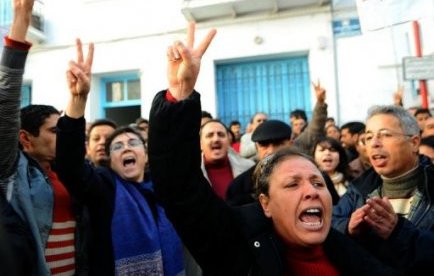
Plusieurs composantes de la société civile ont décidé d’organiser une manifestation, ce vendredi devant le siège du gouvernorat de Sidi Bouzid au lendemain d’une nuit agitée dans la localité d’El Omrane au cours de laquelle 30 personnes ont été arrêtées suite aux affrontements entre sit-inneurs et les forces de l’ordre.
Parmi les personnes arrêtées figurent deux femmes et Abdessalem Hidaoui membre du syndicat de l’enseignement secondaire, a indiqué à TunisieNumerique Lazhar Gharbi porte-parole du Front du 17 Décembre.
La manifestation de ce vendredi 28 septembre à laquelle participent des syndicalistes, des juristes, des membres du front du 17 décembre, des membres du comité de défense de la révolution, vise à dénoncer les incidents de jeudi soir lors de l’intervention des forces de sécurité pour lever le sit-in organisé par les habitants de la localité d’El Omrane.
Selon Lazhar Gharbi le syndicat de l’enseignement secondaire a décrété une grève au niveau local pour ce vendredi, affirmant que tous les établissements de la délégation de Bouzaïane ont été fermés.
Suite aux tragiques événements survenus récemment à Lampedusa, le Forum Tunisien pour les droits Économiques et Sociaux (FTDES) et le Réseau Euro-Méditerranéen pour les Droits de l’Homme (REMDH) vous invitent ce vendredi 28 septembre à une table ronde intitulée „Le naufrage des 6-7 septembre à la lumière de la situation migratoire entre l’Italie et la Tunisie“.
Cette table ronde se tiendra durant toute la journée à l’hotel Majestic, 36 avenue de Paris à Tunis.
Seit zwei Tagen ist in Calais die Hölle los: Die Polizei räumt alle Plätze der Flüchtlinge und läßt sie auch nicht mehr zurückkommen. Es regnet ununterbrochen und die Flüchtlinge wissen nicht, wo sie unterkommen können.
Im Folgenden zwei kurze Berichte auf Englisch mit der Bitte, diese weiterzuleiten.
Die No Border Menschen haben keine Zelte mehr und kaum noch Decken, die austeilen können. Also ein dringender Hifeaufruf um Zelte und Decken!
Weiterlesen »
AS REFUGEES FLOOD TURKEY, ASYLUM SYSTEM NEARS BREAKDOWN
by Susanne Güsten
[…] Asylum is not on offer for Africans and other non-Europeans in Turkey, which retains a “geographical limitation” to the Geneva Refugee Convention, effectively limiting asylum to refugees from Europe.
But Ivorians are only the most recent arrivals in Kumkapi. They join thousands of Iraqis, Iranians and Afghans, as well as Somalis and Congolese, who have run as far as they can and now find themselves unable to proceed further and stuck in a country that precludes asylum for refugees fleeing events occurring outside of Europe.
For many years, the U.N. agency has picked up the slack in Turkey, screening asylum applications and resettling refugees in countries like the United States, Canada and Australia. But with the number of refugees swelling drastically and resettlement quotas shrinking, the system is headed for a breakdown.
Nearly 29,000 incoming refugees registered with the United Nations in Turkey by Aug. 31 this year, according to figures provided by the agency. That figure does not include an estimated 125,000 Syrian refugees sheltering in camps and private accommodation in the southern border area. It also excludes thousands of unregistered refugees, like those in Kumkapi.
Even so, only France, Germany, Italy, Belgium and Sweden, among E.U. countries, received more asylum applications in all of last year, according to Eurostat figures.
The figure in Turkey is sharply higher than an average of 10,000 to 15,000 annually in recent years, according to Multeci-Der, a private group supporting refugee rights. “It is a record number for Turkey,” the association’s chairman, Taner Kilic, said last week.
At the same time, resettlement quotas are down from about 6,500 places last year to fewer than 6,000 this year, according to the U.N. agency, with the United States accepting about 4,000 refugees in 2012 and Canada offering 900 places. Australia is taking 630 refugees, with Norway and Finland offering 150 places each and Germany taking 100 refugees.
“A refugee entering Turkey today will wait for a year and a half just to register with the U.N.H.C.R. and another year for his first interview with them,” Mr. Kilic said. “That’s a two-and-a-half-year wait, just for your first chance to plead your case.” With follow-up interviews and appeals, the average wait for a decision is four to five years, he added, with some refugees waiting seven to eight years before they even become eligible for resettlement.
Third countries then choose among the eligible refugees according to criteria like education, language skills and nation of origin. “Afghans, for example, currently have virtually zero chance of being resettled,” Mr. Kilic said, citing cases of recognized refugees who have been waiting 10 years in what are often miserable conditions.
It is the uncertainty of that wait more than anything else that leads refugees to resort to the desperate action of boarding a smugglers’ boat like one that sank off Turkey’s western coast last month, drowning more than 60 refugees on their way to Europe, Mr. Kilic said.
While Turkey does grant temporary protection to registered refugees while their applications are being considered by the U.N. agency, it requires them to sit out the wait in one of 53 provincial towns to which they are assigned by the Interior Ministry. “But no one tells them how to get there or what to do when they arrive, no one asks where they will sleep, what they will eat and how they will survive,” Mr. Kilic said.
Asylum seekers are neither entitled to material assistance nor granted work permits, leaving them at the mercies of provincial authorities and driven to work illegally. They are frequently subject to detention and deportation by the Turkish authorities without recourse to legal appeal.
It is criticism of such conditions that led lawmakers to draft Turkey’s first asylum law, submitted to Parliament just before the summer recess and due to be voted on soon after it reconvenes next week. The draft law has been greeted with praise by activists and academics, who were consulted in its preparation by the Interior Ministry to an extent that is highly unusual in Turkey.
“They invited us to the ministry and sat down with us, and we went over the law for two days, article by article, and then they did the same with the academics,” Mr. Kilic said. Officials drafting the law also traveled to Strasbourg and Brussels to consult the European Court of Human Rights and the European Commission. The result is an asylum law that not only meets E.U. standards, but exceeds them, experts agree.
“The law has been deeply influenced by the rulings of the European Court of Human Rights,” specifically addressing the issues raised by the court, Kemal Kirisci, a professor of political science at the Bosporus University and one of the country’s leading experts on asylum issues, said in an interview last week. The draft law, which was supported in committee by all parties represented in Parliament, “puts the accent on human rights rather than on security,” he said.
There is just one problem, activists like Mr. Kilic say: The new asylum law will not extend asylum to refugees from outside Europe, because it does not lift the geographical limitation.
“Over all it is a good law, but in my view as long as the geographical limitation is maintained, it remains problematic,” Mr. Kilic said. “We will continue to depend on the U.N. to resettle refugees in third countries, and if those countries will not take them — perhaps pointing out that our economy is now stronger than theirs and that the refugees have fled to our country, not theirs — then we have a deadlocked system.”
But Mr. Kirisci is among those who argued for keeping the geographical limitation in place. “If Turkey were to lift the geographical limitation without being a member of the European Union, I think it would fall into a situation worse than that Greece, an E.U. member, has found itself in over the last couple of years,” he said, pointing to the overwhelming numbers of refugees there and the international criticism of Greece’s handling of the situation.
Turkey would have to lift the geographical limitation to accede to the European Union, Mr. Kirisci conceded. But for now, Turkey is within its rights under international law in maintaining the restriction, he said.
“Why should Turkey give away such a right without European Union membership itself?” Mr. Kirisci said. “I see this as a hard bargaining chip with the European Union”.
http://www.nytimes.com/2012/09/27/world/middleeast/as-refugees-flood-turkey-asylum-system-nears-brea
kdown.html?partner=rss&emc=rss
URGENT APPEAL: blankets, sleeping bags, tents, waterproofs, warm clothes etc. desperately needed as the police keep destroying everything. The manhunt continues, under the pouring rain. Complete list of materials needed and contacts below.
Chiara
26.09.12: Eviction of Salam followed by mass road block next to the port. Lighthouse area also evicted. Mass arrests.
Pictures to come…
Yesterday morning at 6am many many police – PAF and CRS – arrived at the place of food distribution and kicked everybody out in the rain. A lot of people were arrested, around 50 people, and everyone was not allowed to take their blankets or sleeping bags with them (which had just been distributed two days before by Medicin du Monde) though they were able to take some personal bags.
People were released throughout the day – though not everybody, some still remain in the detention centre.
After the food distrobution by Salam at 6pm more blankets were distributed. Many people from the associations gathered in the distribution place and it was decided together by many communities that they wanted to make a road block in protest to the eviction that morning.
It was very beautiful to see, maybe 100 people or less sat and stood in the road to the port and blocked traffic. Plastic sheeting was brought and people made makeshift tents over the road. Cardboard sheets were written on with slogans like “where are our human rights?” and “we are not criminals!”.
Chanting and singing and dancing made the atmosphere a bit like a surreal party. There were many police – Nationale, PAF, BAC – who stood and watched for a couple of hours at a distance, directing traffic. A huge storm came over the demonstrators with thunder and lighting and terrible rain – people held out in the road in the rain until it was totally dark before dispersing to find places to sleep.
This morning at 6.30am the police came again in HUGE numbers. PAF and CRS. They evicted the area outside of the food distribution and arrested everyone. They were not very violent but really unpleasant.. They woke people by cutting the tents from over their heads and stamping on the plastic, with people sleeping inside. It was very cold and the CRS found it amusing that so many people were shivering and wrapping themselves in blankets.
The translator they brought with them did not speak Pashto or Dari – only Arabic. 95% of the people arrested were Afghan and so the woman walking round screaming in Arabic that everybody must go to the police station to show their papers and could take there bags, was not understood.
In the police station people were divided into language groups, Pashto/Dari/Farsi/Arabic/Urdu and put into cells. The police were calling the porta-cabin where most of their cells are, “la maison Afghanistan”.
We are unsure at the moment how many people are left inside – but it seems most are released. The last person from “la maison Afghanistan” was released today but we are still not sure about the other police cells.
It seems somewhat like a bad joke here at the moment. With the constant rain and now what seems to be becoming an eviction trend the days are very long and uncomfortable. We desperately need more tents/sleeping bags/blankets/waterproof coats etc.
For more information, photos, updates to come:
http://calaismigrantsolidarity.wordpress.com/
What we need:
– Tents, tarpaulin, blankets, sleeping bags, men’s clothes: jackets, jumpers, trousers, T shirts M/S, hats, scarves, gloves, underwear, socks, men’s shoes– we need lots of them.
– Books – in any and all languages. Especially, English, French, Italian, Arabic, Pashto, Farsi, Tigrinya, Amharic and Greek. Language dictionaries would be really really cool, and really well used. (We have many in German and Swedish already so don’t need any more!)
– Games – card games, board games, dominoes etc..
– Tools/bike equipment – the bike workshop space is good but could be excellent. We need tools and other equipment and as usual more bikes and trailers.
– Phone chargers and English sim cards (Lyca and O2)
– Also we are in DESPERATE need of cameras… We are missing so much potential footage that could be used against the police.
And if you have any spare time we would love to see you because we have a massive shortage of activists but so much to do!!
Contact :
00 33 6 45 46 59 86 (from outside France)
06 45 46 59 86 (from inside France)
Email: calais_solidarity@riseup.net
Vergessen in der Wüste
Ein Bericht über Flüchtlingslager Shousha von Sabine Schmidtke
Im Rahmen des Projekts boats4people hat eine internationale Delegation bestehend aus 11 Personen aus 9 verschiedenen Ländern am 11.7.2012 das Flüchtlingslager Shousha in Tunesien wenige Kilometer vor der libyschen Grenze besucht. Unter den TeilnehmerInnen befand sich auch eine Vertreterin von borderline-europe, Menschenrechte ohne Grenzen e.V.
http://www.borderline-europe.de/downloads/2012_09_24_Shousha_Bericht.pdf
Angehörige von Boat-people, die im März 2011 Italien erreicht haben sollen, aber verschollen sind, haben in Tunis Klage eingereicht, anscheinend gegen die Untätigkeit der Behörden.
Seit zwei Wochen halten im Raum von Sidi Bouzid im tunesischen Landesinneren Proteste in Form von Straßenblockaden an. Die Überlandstraße Sfax-Gafsa ist dadurch gesperrt. Am 26.09.2012 hat die Polizei 13 Blockierer verhaftet, aber die Straßenblockaden gehen weiter.
http://www.tap.info.tn/fr/fr/component/content/article/378-actualite/33518-sidi-bouzid-arrestation-de-13-personnes-suite-au-blocage-dune-route.html
„WikiLeaks founder Julian Assange accused President Barack Obama today of seeking to exploit the Arab uprisings for personal political gain, as he addressed a sideline meeting of the UN General Assembly via videolink from his hideout at a London embassy. […]
„It must come as a surprise to Tunisians for Barack Obama to say the US supported the forces of change in Tunisia,“ Assange said, speaking from Ecuador’s tiny apartment-sized London mission. He claimed that uprisings across the Arab world had been inspired, in part, by his organization’s disclosures about despotic rulers, including Tunisia’s deposed President Zine El Abidine Ben Ali. Assange claimed that Obama whose administration he accuses of building a criminal case against WikiLeaks and of harassing its staff was seeking to exploit the reforms of the Arab Spring during his reelection campaign. „Mohamed Bouazizi did not set himself on fire so that Barack Obama could get reelected,“ Assange told the meeting, referring to the 2011 self-immolation by a Tunisian fruit vendor which sparked the uprising that toppled Ben Ali.“
http://www.nzherald.co.nz/world/news/article.cfm?c_id=2&objectid=10836901